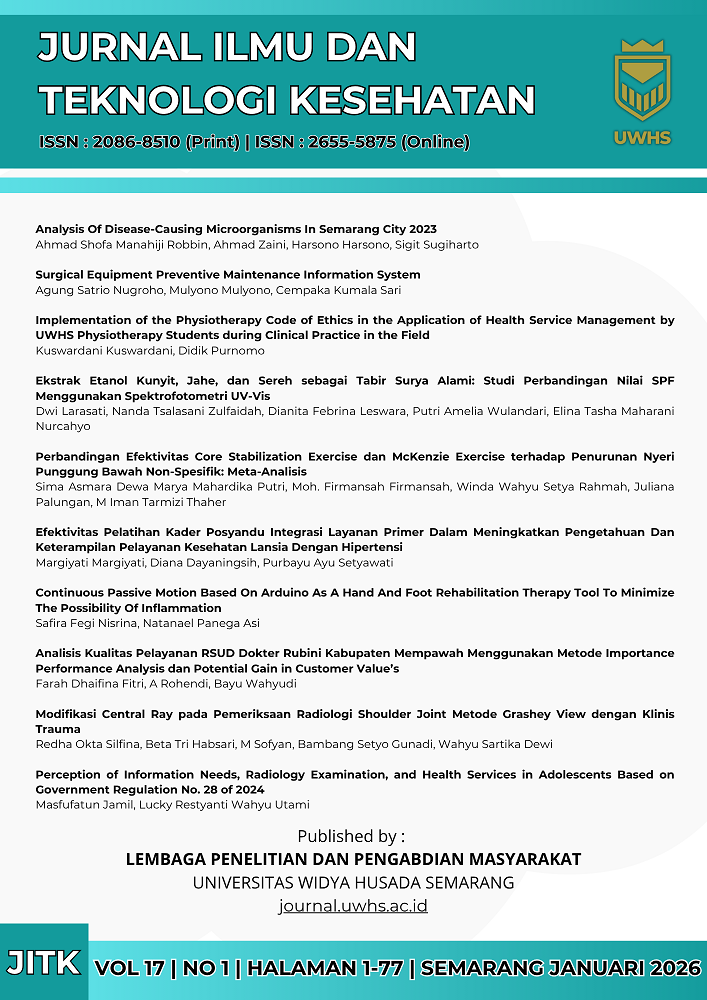
Ekstrak Etanol Kunyit, Jahe, dan Sereh sebagai Tabir Surya Alami: Studi Perbandingan Nilai SPF Menggunakan Spektrofotometri UV-Vis
Abstract
Paparan sinar ultraviolet (UV) dapat menimbulkan berbagai kerusakan kulit, seperti penuaan dini, hiperpigmentasi, dan peningkatan risiko kanker kulit. Upaya pencegahan semakin berkembang melalui pemanfaatan bahan alam yang memiliki kemampuan menyerap sinar UV. Penelitian ini bertujuan untuk membandingkan nilai Sun Protection Factor (SPF) dari ekstrak etanol kunyit (Curcuma longa L.), jahe (Zingiber officinale Roscoe), dan sereh (Cymbopogon citratus DC.) sebagai kandidat bahan aktif tabir surya alami. Ekstraksi dilakukan secara maserasi menggunakan etanol, kemudian larutan diuji menggunakan spektrofotometer UV-Vis pada konsentrasi 100–300 ppm. Nilai SPF dihitung menggunakan persamaan Mansur dan dianalisis secara deskriptif serta uji Kruskal–Wallis untuk mengetahui perbedaan antar kelompok. Hasil menunjukkan bahwa nilai SPF meningkat seiring kenaikan konsentrasi, dengan ekstrak kunyit memiliki nilai tertinggi (7,649–22,554), diikuti sereh (3,934–11,833) dan jahe (2,369–6,512). Variasi nilai SPF dipengaruhi oleh perbedaan kandungan senyawa aktif, seperti kurkumin pada kunyit, citral pada sereh, dan gingerol pada jahe. Secara keseluruhan, ketiga ekstrak berpotensi menjadi agen tabir surya alami, dengan kunyit sebagai kandidat utama karena memberikan perlindungan UV paling efektif.
References
Khetarpal S, Tomecki KJ. Sunscreens and Ultraviolet Light: What you need to know. Men’s Health A Head to Toe Guide for Clinicians. p. 17–21.
McDaniel D, Farris P, Valacchi G. Atmospheric skin aging—Contributors and inhibitors. Vol. 17, Journal of Cosmetic Dermatology. Blackwell Publishing Ltd; 2018. p. 124–37.
Reinau D, Osterwalder U, Stockfleth E, Surber C. The meaning and implication of sun protection factor. Vol. 173, British Journal of Dermatology. Blackwell Publishing Ltd; 2015. p. 1345.
Schneider SL, Lim HW. Review of environmental effects of oxybenzone and other sunscreen active ingredients. Vol. 80, Journal of the American Academy of Dermatology. Mosby Inc.; 2019. p. 266–71.
Cefali LC, Ataide JA, Moriel P, Foglio MA, Mazzola PG. Plant-based active photoprotectants for sunscreens. Vol. 38, International Journal of Cosmetic Science. Blackwell Publishing Ltd; 2016. p. 346–53.
Gǎlbǎu CŞ, Irimie M, Neculau AE, Dima L, Pogačnik da Silva L, Vârciu M, et al. The Potential of Plant Extracts Used in Cosmetic Product Applications—Antioxidants Delivery and Mechanism of Actions. Vol. 13, Antioxidants. Multidisciplinary Digital Publishing Institute (MDPI); 2024.
Sabale P, Modi A, Sabale V. Pharmacognosy and Phytochemistry. Research Journal of Pharmacognosy and Phytochemistry. 5(2):59–68.
Shabrina AM, Azzahra RSS, Permata IN, Dewi HP, Safitri RA, Maya I, et al. Potential of Natural-Based Sun Protection Factor (SPF): A Systematic Review of Curcumin as Sunscreen. Vol. 12, Cosmetics. Multidisciplinary Digital Publishing Institute (MDPI); 2025.
Guo J, Wu H, Du L, Zhang W, Yang J. Comparative Antioxidant Properties of Some Gingerols and Shogaols, and the Relationship of Their Contents with the Antioxidant Potencies of Fresh and Dried Ginger (Zingiber officinale Roscoe). Vol. 16, J. Agr. Sci. Tech. 2014.
Kim JK, Kim Y, Na KM, Surh YJ, Kim TY. [6]-gingerol prevents UVB-induced ROS production and COX-2 expression in vitro and in vivo. Free Radic Res. 2007;41(5):603–14.
Madan V. A Review on the Phytochemistry and Pharmacology of Cymbopogon citratus Stapf. (Lemongrass). The Pharma Innovation Journal [Internet]. 2018;300(3):300–4. Available from: www.thepharmajournal.com
Korać RR, Khambholja KM. Potential of herbs in skin protection from ultraviolet radiation. Vol. 5, Pharmacognosy Reviews. 2011. p. 164–73.
Petruk G, Giudice R Del, Rigano MM, Monti DM. Antioxidants from plants protect against skin photoaging. Vol. 2018, Oxidative Medicine and Cellular Longevity. Hindawi Limited; 2018.
Ramadhani S, Nyoman I, Lister E, Fachrial E, Nasution H. Antiaging Cream Formula From Lemongrass Leaf Extract (Chymbopogon Citratus) [Internet]. International Journal of Health and Pharmaceutical. Available from: https://ijhp.net
Poh KH, Muhammad N, Abdullah N, A. Talip B. The Evaluation of Antioxidant Activity of Individual and Mixture of Lemongrass, Curry Leaves, Turmeric and Ginger Extracts. Journal of Science and Technology [Internet]. 2018 Feb 1;10(2). Available from: http://penerbit.uthm.edu.my/ojs/index.php/JST/article/view/2958/1583
Rathaur P, Raja W, Ramteke PW, John SA. TURMERIC: THE GOLDEN SPICE OF LIFE. IJPSR [Internet]. 2012;3(7):7. Available from: www.ijpsr.com
Rastuti, U., Sulaeman, U., Widyaningsih, S., Zia, S. K., & Mahendra, R. A. (2022).
Liu X, Zhang R, Shi H, Li X, Li Y, Taha A, et al. Protective effect of curcumin against ultraviolet A irradiation-induced photoaging in human dermal fibroblasts. Mol Med Rep. 2018 May 1;17(5):7227–37.
Copyright (c) 2025 Dwi Larasati, Nanda Tsalasani Zulfaidah, Dianita Febrina Leswara, Putri Amelia Wulandari, Elina Tasha Maharani Nurcahyo

This work is licensed under a Creative Commons Attribution 4.0 International License.